




A new search label seems to arrive before marketing teams have finished budgeting for the last one.
Founders are hearing pitches for Answer Engine Optimization. SEO managers are being offered Generative Engine Optimization services. Board members are asking about ChatGPT visibility while competitors mention LLM optimization in sales calls, webinars, and LinkedIn posts.
At the same time, plenty of company websites still need basic improvements, including sparse service pages, ill-defined positioning, a deprioritized technical SEO foundation, and shallow, keyword-stuffed blogging.
This creates a dilemma: do you hire a dedicated AI search partner, or do you build AI search into the strategy already supporting your website?
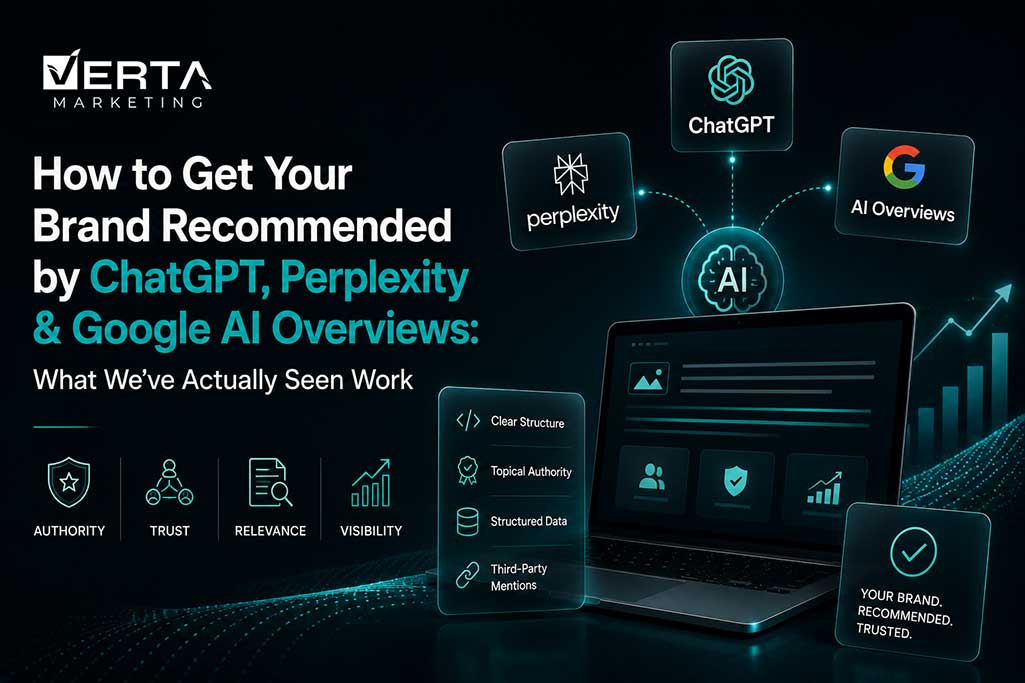
AI search works best as an extension of strong SEO. While specialists are valuable for advanced audits, most businesses see better results by folding AI search optimization, AEO, GEO, and LLM visibility into one modern SEO strategy instead of fragmenting their marketing efforts.
Verta’s Perspective
At Verta Marketing Inc., our team has tested different ways to approach AI search across internal projects and client strategies. Some work was treated as a separate specialist function. Some were handled through standalone audits. Some was built directly into existing SEO work through expert content planning, technical reviews, prompt testing, source analysis, entity refinement, and reporting.
The integrated model has been the most practical.
AI search has changed how people discover information. For instance, buyers may:
- See summaries in Google AI Overviews
- Ask ChatGPT for provider suggestions
- Use Perplexity to check cited sources,
- Use Claude for longer research-style answers
Visibility no longer depends only on ranking in a familiar list of blue links.
Even so, AI systems still need usable information. They need pages they can access, content they can understand, and brand signals they can place in context. A weak website does not become stronger because a proposal includes newer terminology.
A strong AI search SEO strategy starts with familiar priorities:
- Technical access and crawlability
- Strong service and product pages
- Helpful content written for buyer decisions
- Consistent brand, service, and entity information
- Relevant third-party mentions
- Internal links and logical site structure
- Reporting tied to traffic quality, leads, pipeline, and revenue
AI search adds a new layer of testing and interpretation. It helps a business see how AI platforms describe the brand, which competitors appear, which sources get cited, and where content needs to become easier to retrieve or summarize.
For Verta, the best model is one connected roadmap. SEO builds the foundation. AI search testing sharpens the strategy.
Why The Specialist Debate Started
The market confusion makes sense because search behaviour has changed quickly.
As mentioned earlier, buyers today no longer rely solely on Google; they now curate shortlists via ChatGPT, research third-party comparisons on Perplexity, and consult various industry resources before ever visiting a company’s website.
Marketing teams naturally want to know how to show up in these new environments. They can now leverage a few emerging strategies:
- Answer Engine Optimization: Focuses on answer-style discovery.
- Generative Engine Optimization: Looks at visibility within AI-generated responses.
- LLM Optimization: Addresses how large language models understand and mention brands.
- AI Search Optimization: Acts as the broader term for improving visibility across all AI-powered search experiences.
While these terms help us categorize the new landscape, they are only the starting point. To truly master them, we must first look at the foundational work that makes such visibility possible in the first place.
What AI Search Needs Before It Can Mention A Brand
AI search feels conversational, but the process still depends on information retrieval. Before an AI platform can recommend a company, compare it with competitors, or cite it in an answer, it needs information from somewhere. Sources may include the company website, search indexes, third-party articles, review platforms, directories, forums, documentation, media coverage, and industry pages.
Each platform handles retrieval differently. Google’s AI experiences are closely connected to Google Search systems. Perplexity is built around answers with visible citations. ChatGPT and Claude can use current web information through search or browsing features. Platform behaviour varies, but the business lesson stays consistent: weak public information leads to weaker visibility.
SEO has always dealt with access, meaning, authority, and usefulness. AI search makes those areas even more visible because platforms are summarizing, comparing, and citing information in front of the buyer. A practical AI search strategy rests on three building blocks.
Access
Search systems and AI platforms need access to important content. Technical SEO plays a major role here because hidden, blocked, duplicated, or poorly rendered pages limit visibility.
Access usually involves:
- Crawlable pages and healthy indexation
- Clean site architecture and logical internal linking
- Readable on-page text, including proper handling of JavaScript-rendered content
- Fast, stable, mobile-friendly pages
A company can run prompt tests across every AI platform, but poor technical access will still hold the site back.
Understanding
AI platforms need enough information to understand the business accurately. Vague language creates weak summaries. Unclear service pages make comparison harder. Inconsistent naming across the web can confuse search systems and buyers alike.
Understanding improves through:
- Clear service, product, and category pages, organized around buyer problems and decision stages
- Consistent brand descriptions and accurate author, founder, team, and company information
- Helpful schema where appropriate
- Specific examples of who the company serves
A page should make the business easy to interpret without forcing the reader to connect missing pieces.
Usefulness
AI platforms are more likely to surface content with enough substance to answer buyer needs. A basic blog post targeting one keyword rarely carries the same value as a detailed comparison page, category guide, or service page with specific explanations.
Useful content often includes:
- Buyer questions answered in plain language
- Comparison points between services, providers, or approaches
- Clear explanations of process, pricing factors, timelines, and fit
- Examples from common customer situations and evidence of expertise, experience, and authority
- Content written for decision-making instead of keyword coverage alone
Strong SEO and strong AI search visibility both depend on content worth retrieving.
Where AI Search Adds Its Own Value
AI search should sit near SEO, but it still brings new work to the table.
Traditional SEO reporting has established metrics such as rankings, impressions, clicks, organic sessions, conversions, indexed pages, crawl data, and landing page performance. AI search visibility is less stable because outputs can vary by platform, prompt wording, model version, timing, location, and account context.
A business may rank well in Google and still appear weakly in AI-generated answers. A competitor may appear often because third-party sources describe them better. A brand may be mentioned inaccurately because public information is outdated or inconsistent.
AI search testing helps reveal those patterns.
A useful AI search optimization layer may include:
- Testing prompts based on how buyers research vendors
- Reviewing competitor mentions in AI-generated answers
- Tracking cited sources across platforms
- Checking whether brand descriptions are accurate
- Identifying pages AI systems can summarize easily
- Reviewing third-party sources influencing category visibility
- Improving comparison, category, and decision-stage content
- Monitoring Google AI Overviews, Google AI Mode, ChatGPT, Perplexity, Claude, and other relevant tools
The value comes from using those findings to improve the website, content plan, authority work, and reporting. AI search research should create better SEO decisions, not a second strategy competing for the same budget.
The Problem With Separating SEO And AI Search
A separated model can look organized at first. One team handles SEO. Another team handles AI search visibility. Each team has its own audits, meetings, dashboards, and recommendations.
Problems usually appear once both teams begin working on the same website.
Overlapping Recommendations
AI-search audits often recommend stronger comparison pages, clearer category content, better entity consistency, improved service pages, and stronger external mentions. SEO teams often recommend the same work because it supports organic visibility and buyer intent.
A business may end up paying twice for similar recommendations, then spending extra time deciding which roadmap gets priority.
Confused Technical Priorities
AI search recommendations often depend on technical SEO. Content needs to be accessible. Pages need clear structure. Internal links need to connect related topics. Important information should be readable in the page text.
A separate AI-search report may identify retrievability issues while the SEO team is already managing indexation, rendering, crawl paths, duplicate content, and site architecture. Without one shared technical roadmap, priorities become harder to manage.
Messy Reporting
SEO reporting usually focuses on rankings, organic traffic, leads, conversions, and revenue. AI-search reporting may focus on prompt tests, brand mentions, citations, and visibility snapshots.
Both views matter, but leadership needs one connected picture of search performance. Separate reporting can make progress feel harder to interpret, especially when content and technical work influence both sets of outcomes.
Inefficient Content Planning
A company may need one strong comparison page, one detailed buying guide, or one improved service page. Separate teams can turn the same need into multiple briefs, each framed around a different objective.
Content works better when writers have one clear audience, one search strategy, and one business goal.
Where A Dedicated AI Search Partner Can Help
A dedicated AI search partner can be useful in the right situation. Larger brands, competitive B2B companies, SaaS firms, ecommerce sites, healthcare-adjacent businesses, education organizations, and high-consideration service providers may need deeper visibility research across AI-powered platforms. Those businesses often have more complex buying journeys, stronger competitors, and higher stakes around brand representation.
Dedicated support can help with:
- Advanced AI visibility audits
- Prompt and query monitoring
- Competitive visibility reviews
- Citation and source analysis
- Content retrievability testing
- Enterprise reporting design
- AEO and GEO experimentation
- Brand and entity consistency reviews
- Platform-specific observation across ChatGPT, Perplexity, Claude, and Google AI experiences
Specialist support works best for companies with a mature SEO base. Strong technical health, well-developed service pages, useful content, clean analytics, and credible authority signals give AI-search research something meaningful to build on.
The specialist should still work closely with SEO, content, analytics, PR, brand, and development teams. Separate expertise can add depth. A separate silo usually adds friction.
The Better Model: AI Search As A Layer On SEO
Verta recommends a layered model.
The foundation is modern SEO. The added layer is AI search optimization.
The SEO foundation covers:
- Technical access
- Indexation
- Information architecture
- Internal linking
- Service and product page quality
- Structured data where useful
- Content strategy
- Authority building
- Local or product visibility where relevant
- Analytics and conversion tracking
The AI-search layer adds:
- Prompt testing
- Citation review
- Competitor visibility checks
- Brand representation analysis
- Source pattern research
- Content retrievability reviews
- Platform-specific monitoring
- AEO, GEO, and LLM optimization testing
Together, those layers give leadership one roadmap, writers one content strategy, developers one technical priority list, and marketing teams one way to connect search visibility to business performance.
The right level of AI search investment depends on business maturity, search competition, and the quality of the existing SEO foundation.
What The Budget Decision Should Look Like
The budget should follow the stage of the search strategy. AI adoption is rising. Statistics Canada reported that 7 percent of Canadian businesses with five or more employees used AI technologies in 2023, and a 2026 Statistics Canada analysis reported that 12.2 percent of Canadian firms used AI to produce goods or deliver services in 2025.
Digital visibility already affects how customers discover and evaluate businesses. AI-powered search adds another discovery surface, but a standalone AI-search program rarely makes sense before the foundation is in place.
A company with weak technical SEO, thin service pages, unclear positioning, limited authority, and poor analytics will usually get more value from fixing those areas first. AI search testing becomes more useful once there is strong content and credible information for platforms to retrieve, summarize, and cite.
A sensible investment sequence looks like this:
- Improve crawlability, indexation, page structure, and technical access.
- Strengthen service pages, product pages, category pages, comparison pages, and decision-stage content.
- Build topical authority through specific, useful, expert-led content.
- Improve brand and entity signals across the website and credible third-party sources.
- Add AI visibility testing across Google AI Overviews, Google AI Mode, ChatGPT, Perplexity, Claude, and other relevant platforms.
- Connect reporting to traffic quality, conversions, pipeline, and revenue.
Budget decisions become easier once AI search is treated as part of the wider search strategy. The business can invest in the foundation first, then add deeper AI visibility work as the strategy matures.
How Verta Approaches SEO And AI Search Together
Verta Marketing Inc. helps businesses build search strategies designed for both traditional organic visibility and AI-powered discovery.
Our work can include technical SEO, content strategy, non-commodity content development, entity optimization, internal linking, authority analysis, AI search visibility audits, AEO testing, GEO testing, LLM visibility reviews, and ongoing platform observation.
We keep our focus practical. We believe that not every brand needs a separate strategy for every AI platform. It needs a strong website, accessible content, clear expertise, consistent entity information, credible external signals, and a testing process based on how buyers now research options.
For example:
- A B2B service company may need stronger service and category pages before investing in advanced AI monitoring.
- A SaaS company may need comparison pages because AI tools often help buyers compare vendors.
- A local service business may need cleaner location, service, and review signals before focusing on Perplexity or ChatGPT visibility.
- An enterprise brand may need ongoing AI visibility reviews because buyers, analysts, journalists, and procurement teams may already be asking AI tools about the company.
Every business needs a search strategy suited to its market, website quality, and buyer journey. For Verta, the operating principle remains consistent: build the SEO foundation, then use AI search insights to refine visibility across newer discovery platforms.
Final Thoughts
AI search is changing discovery, but strong SEO still carries much of the work.
Search now appears through summaries, citations, comparisons, and conversational answers. Google AI Overviews, Google AI Mode, ChatGPT, Perplexity, and Claude all deserve attention because buyers may use several of them before contacting a company.
The strongest foundation remains familiar: crawlability, technical health, useful content, topical authority, clear site structure, credible sources, and consistent brand information.
For most companies, AI search optimization belongs inside SEO rather than beside it as a separate silo. Dedicated specialists can support deeper audits, prompt testing, citation analysis, and experimentation, but their work should connect to content, technical SEO, analytics, brand, and business goals.
Verta Marketing Inc. helps businesses build a connected approach to modern SEO, Answer Engine Optimization, Generative Engine Optimization, LLM optimization, and AI search visibility so search efforts support one strategy instead of competing for attention and budget.