



Every B2B marketing leader asks the exact same question before signing off on an organic growth strategy: How long until this actually drives the pipeline?
The standard agency response is a well-rehearsed platitude about a four to six-month window. It is a safe answer, but it is rarely a useful one.
Treating SEO timelines like a universal law of physics ignores the messy reality of your digital starting point. A brand-new SaaS platform launching from zero does not move at the same speed as an established enterprise domain drowning in years of technical debt.
Organic search does not operate on a standardized corporate calendar. It operates on momentum. Long before a campaign delivers a dramatic spike in qualified leads, it builds pressure quietly under the surface. You see it first in cleaner crawl health, rising impressions, and steady keyword movement on high-intent pages.
To build an organic channel that outlasts your ad budget, you have to trade comfortable, arbitrary timelines for commercial reality. Here is a transparent look at how long SEO actually takes to work, based on the concrete patterns observed across real B2B campaigns.
SEO Timeline At A Glance
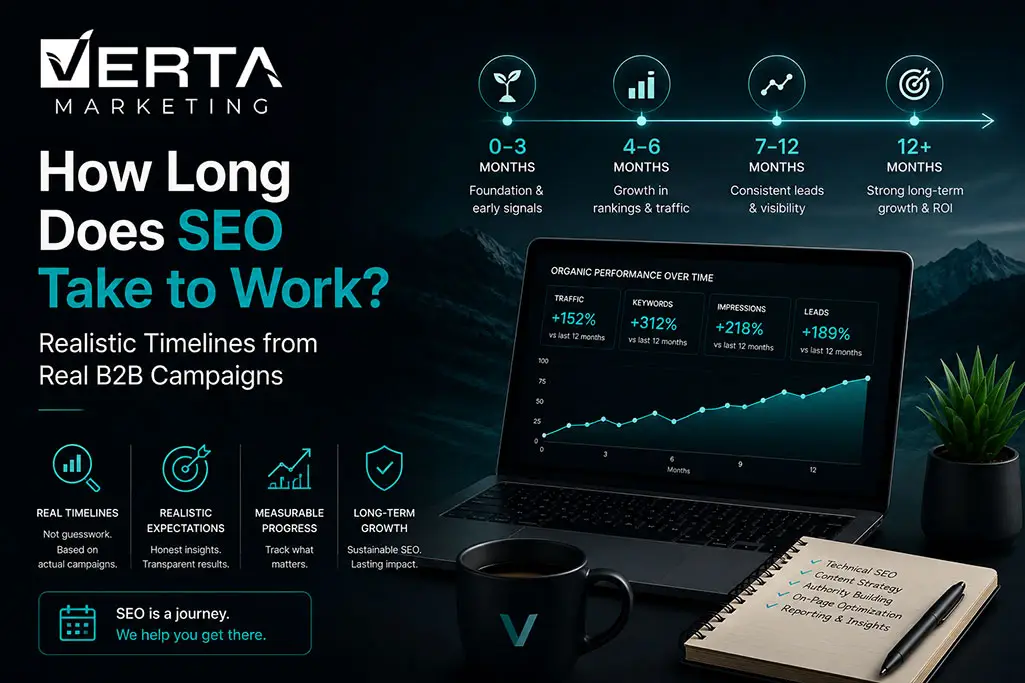
No honest agency can promise the same timeline for SEO results for every business. The table below reflects the patterns Verta Marketing Inc. commonly sees across B2B campaigns. Every campaign moves at its own pace; consider these windows a typical baseline.
| Business Scenario | First Signs Of Progress | Meaningful SEO Results | Strong Long Term Growth |
| Brand new website | 3 to 4 months | 6 to 9 months | 12 months or more |
| Established website with authority | 2 to 3 months | 4 to 6 months | 9 to 12 months |
| Competitive B2B market | 4 to 6 months | 8 to 12 months | 12 to 18 months |
| Website with technical debt | 3 to 5 months | 6 to 9 months | 12 months or more |
Early SEO progress appears as structural momentum rather than an immediate traffic spike.
Initial traction occurs across foundational layers: accelerated page indexation, an expanding footprint of keywords entering the top 50, upward mobility on core commercial pages, and rising impression volume in Google Search Console.
These developments are critical leading indicators, confirming that the site is building algorithmic pressure well before the results materialize as lead volume.
What Influences SEO Timelines?
How long SEO takes to work depends entirely on the initial diagnosis. Time alone does not generate results. Progress requires optimizing the right elements of the website, in the correct order.
Domain History And Search Authority
Older domains often have an advantage because Google already has a history with the website. Search engines have seen the pages, crawled the structure, observed the backlink profile, and collected behavioural signals over time.
A new domain has to build that record from the ground up. It needs useful content, clean technical foundations, relevant internal linking, and external signals from credible sources. A new website can still grow, but it usually needs more time before search engines treat it as a reliable source in a competitive market.
Authority also depends on how the brand is represented beyond its own website. Partner mentions, industry associations, software directories, review platforms, digital PR, podcast features, and expert citations can all support organic growth when they are relevant and credible.
Website Quality Before SEO Begins
Some websites enter SEO with useful assets already in place. Others have thin service pages, weak navigation, outdated blogs, duplicated copy, broken links, unclear page intent, and content written more for internal approval than buyer education.
A mature website can often improve faster because the campaign can refine existing assets. Verta may begin by upgrading pages already ranking on page two, restructuring important service pages, consolidating competing blog posts, and creating better pathways from informational content to commercial pages.
A weak website needs foundational work first. Growth is still possible, but the early campaign must repair the base before visibility can scale.
Technical Health And Crawl Efficiency
Technical SEO affects how easily search engines can access, understand, and evaluate the website. A company may have strong expertise and useful content, but crawl issues, redirect chains, duplicate URLs, slow templates, poor mobile performance, and confusing architecture can dilute results.
Google describes SEO as work that helps search engines crawl, index, and understand content. For B2B websites, technical SEO improvements can be especially important because service pages, resource hubs, case studies, and product pages often sit inside complex site structures.
A technical fix does not always create instant traffic. It often removes friction so later content and authority work can perform properly.
Content Maturity And Buyer Intent
B2B SEO has to serve a longer decision process. Buyers may search for symptoms, category terms, comparisons, pricing cues, implementation risks, integrations, use cases, vendor criteria, and proof of expertise before speaking with sales.
A shallow content library usually captures only a small part of that research process. A mature content system covers the full buyer path without turning every page into a sales pitch.
Strong B2B content usually includes:
- Core service or product pages built around commercial intent
- Use case pages tied to specific business problems
- Comparison and alternative pages where appropriate
- Technical explainers for complex buying committees
- Industry pages for niche positioning
- Case studies connected to measurable outcomes
- Thought leadership that reflects actual expertise
A company publishing generic blog posts every month may stay busy without building authority. A focused, long-term SEO strategy builds connected content around the buyer’s actual decision process.
Realistic SEO Timelines By Business Scenario
Because a website’s starting point dictates the strategy, blanket estimates are inaccurate. The actual time to revenue depends entirely on the specific business model and current site health.
Scenario 1: Brand New Website
A brand new website usually needs the longest timeline because it has no meaningful search history. The first few months are less about winning high-value rankings and more about creating enough structure for future growth.
Months 1 to 3 often involve analytics setup, keyword research, technical configuration, sitemap review, indexation checks, core page creation, and early content publishing. Search engines begin learning the site, but lead generation may remain limited.
Months 4 to 6 may show early keyword movement, especially for branded terms, long tail searches, and niche educational topics. Commercial rankings usually take longer because the website has not yet built enough authority to compete with established players.
Months 7 to 12 are where the campaign becomes more measurable. Content clusters begin supporting service pages, internal links strengthen topic relationships, and ranking data becomes useful enough to refine the strategy.
Scenario 2: Established Website With Existing Authority
An established website can often show progress sooner because the domain already has search signals. The campaign does not need to create every asset from zero.
Verta often finds early opportunities inside pages already getting impressions but underperforming in clicks or rankings. A service page sitting around positions 8 to 20 may need stronger structure, clearer content depth, better metadata, internal links from relevant blogs, and improved conversion paths.
Months 1 to 3 can produce visible movement through content refreshes, technical cleanup, and improved page targeting. Months 4 to 6 often bring more meaningful gains, especially where the website already had authority but lacked disciplined SEO architecture.
The risk with established sites is complacency. A website with years of content can still underperform if its pages overlap, compete against each other, or fail to match current search intent.
Scenario 3: Competitive B2B Industry
Competitive industries require a more patient timeline because the search results are already occupied by strong domains. SaaS, cybersecurity, manufacturing, financial services, and professional services often involve intense competition from category leaders, directories, review platforms, publishers, and niche experts.
A strong campaign usually grows through specificity first. Instead of chasing broad category terms immediately, Verta may build visibility through use cases, integrations, industry pages, problem-led content, and high-intent comparison searches.
Months 1 to 3 focus on positioning, topic mapping, technical readiness, and priority page development. Months 4 to 6 often show improved impressions and movement across mid-funnel terms. Months 8 to 12 are more realistic for meaningful organic traffic and qualified lead growth, while authority-led gains often continue into months 12 to 18.
Competitive SEO rewards companies that can keep publishing expert content, earn relevant links, update existing assets, and connect SEO work with sales intelligence.
Scenario 4: Website With Significant Technical Debt
Some websites need repair before growth can begin. Technical debt can hide inside an attractive design, especially after migrations, redesigns, platform changes, or years of incremental edits.
Common issues include crawl waste, duplicated pages, missing canonicals, broken redirects, thin indexed URLs, poor internal linking, slow page templates, and confusing navigation. These problems make it harder for search engines to identify the pages that deserve attention.
Months 1 to 3 usually focus on audit work and priority fixes. Months 3 to 5 may show cleaner indexation, better crawl patterns, and more stable keyword movement. Traffic growth often follows later because technical repair improves the site’s ability to perform, but it still needs content and authority to compete.
A technical debt campaign can feel slow at first. The early work is still valuable because it prevents the business from pouring new content into a structure that cannot support it.
What We Have Seen Across B2B Campaigns
The following examples are composite, anonymised patterns based on recurring Verta campaign trajectories. They illustrate how progress tends to develop without presenting isolated outcomes as universal promises.
Established Software Company
Months 1 to 3: The website had authority but weak solution and use-case pages. Existing articles were consolidated, commercial pages were rebuilt and internal links were redirected towards revenue priorities.
Months 4 to 6: Relevant impressions expanded, previously stagnant pages moved and organic search began contributing more qualified enquiries.
Months 7 to 12: Growth became less dependent on a few blog posts. Solution pages, comparison content and expert-led resources started working as a connected acquisition system.
New Professional Services Brand
Months 1 to 3: The campaign established search architecture, service positioning and initial authority signals. Progress centred on indexation, long-tail visibility and branded demand.
Months 4 to 6: More service-related queries entered competitive positions, although lead volume remained uneven while the domain built authority.
Months 7 to 12: Commercial visibility strengthened, supporting content widened the site’s reach and organic enquiries became more consistent.
Industrial Website With Technical Debt
Months 1 to 3: Crawl waste, duplicate pages and weak navigation were repaired before content production scaled.
Months 4 to 6: Indexation improved and priority pages received stronger internal support.
Months 7 to 12: Industry and application pages expanded non-branded reach. Organic traffic became more useful to sales because visitors were landing on pages aligned with genuine buying requirements.
Measuring Progress Before Rankings Take Off
Rankings and revenue are lagging indicators. A well-managed campaign also watches the conditions that tend to precede growth:
- Priority pages being crawled and indexed consistently
- Relevant queries generating more impressions
- Keywords moving into the top 50 and top 20
- Better click-through rates on pages already receiving impressions
- Growth in non-branded commercial visibility
- More qualified sessions reaching solution and service pages
- Stronger conversion rates from organic landing pages
Rankings matter, but rankings without qualified demand can flatter a report. B2B companies need visibility around terms that bring the right buyer closer to a decision.
When is SEO Not Worth it?
SEO deserves honest boundaries. Verta will not recommend SEO as the primary channel for every business, every offer, or every timeline.
A company needing leads within the next few weeks may need PPC, outbound, partnerships, or direct sales before SEO becomes the right investment. Organic search can support the pipeline later, but it rarely solves immediate revenue pressure.
A short campaign built around a temporary offer may also be a poor fit. SEO compounds through content, authority, and trust over time, so a brief promotional window may end before search visibility matures.
A company unwilling to improve its website will also struggle. SEO cannot carry weak positioning, thin content, unclear services, poor technical foundations, or a slow approval process forever. Search performance depends on the quality of the business’s digital presence.
Very limited budgets can still work in narrow markets, but competitive B2B SEO usually needs sustained investment. The budget has to support strategy, technical work, content, reporting, and authority building long enough for the campaign to mature.
How Businesses Can Accelerate SEO Results
Acceleration comes from better prioritisation. Shortcuts rarely create durable growth, especially in B2B markets where expertise and trust carry weight.
A faster campaign usually starts with the work that removes the biggest constraint. For one company, that may mean a technical audit. For another, it may mean rebuilding commercial pages. For another, it may mean replacing generic blog activity with a serious content strategy.
The most effective moves usually include:
- Fixing crawl, indexation, speed, and architecture issues early through technical SEO services
- Prioritising commercial pages before low-intent blog traffic
- Building topic clusters around buyer needs rather than keyword lists alone
- Improving internal linking between educational content and revenue pages
- Updating older content before publishing new content at random
- Creating expert-led assets for competitive B2B searches
- Earning relevant links from credible industry sources
- Connecting SEO reporting with lead quality and sales outcomes
- Expanding into AI search visibility where buyers use tools like ChatGPT, Gemini, Claude, and Perplexity during research
Verta’s SEO services are built around that sequence: audit the starting point, strengthen the foundation, build the right content system, measure leading indicators, and connect organic visibility to commercial outcomes.
Predictable SEO Growth Starts With Verta Marketing Inc.
The definitive timeline for SEO results always depends on where the business stands at day zero. A new website may need 6 to 9 months before meaningful traction appears. An established website with authority may see useful movement in 2 to 3 months and stronger results by months 4 to 6. A competitive B2B market may need 12 months or more before organic search becomes a serious pipeline contributor.
SEO works best when leadership understands the timeline before the campaign begins. Early progress shows up in crawlability, indexation, impressions, keyword movement, and qualified engagement before it appears as steady lead flow.
Verta Marketing Inc’s approach is simple: set the right expectations, build the right foundation, and measure progress in a way that reflects how B2B buyers actually search. SEO is not the fastest channel, but for companies willing to build with discipline, it can become one of the most durable sources of qualified demand.